
AI Visibility helps independent businesses become easier for ChatGPT, Google AI Overviews, Perplexity, and other AI search tools to understand, trust, cite, and recommend.
When potential customers ask AI who to trust, what business to choose, or how to solve a problem, your business needs to be part of the answer.
Ted Yeatts shows small and independent business owners how to improve AI visibility by strengthening the signals that matter most: clear positioning, helpful content, customer-focused service pages, schema markup, local authority, reviews, entity consistency, and practical answers to the questions customers are already asking.
Ted’s AI Visibility work is built around The AI Local Visibility Stack™, a practical four-layer framework that helps business owners understand what AI tools need before they can confidently recommend a local business.

AI Visibility for Independent Businesses
What is AI Visibility?
AI Visibility is the process of making your business easier for AI search tools to understand, trust, cite, and recommend when potential customers ask questions.
Instead of only thinking about search rankings, AI Visibility focuses on whether tools like ChatGPT, Google AI Overviews, Perplexity, and other AI-powered search experiences can clearly understand:
Who you are
What you do
Who you help
Where you serve
Why customers should trust you
What problems you solve
What makes your business recommendable
Which questions your business is qualified to answer
For independent businesses, AI Visibility is becoming part of local authority, reputation, customer education, and digital trust.
Why AI Visibility Matters Now
Customers Are Asking AI Before They Choose
Customers are no longer only searching Google and clicking through a list of websites.
Your customers may already be asking AI tools questions like:
Who is the best service provider near me?
What local business should I choose for this service?
How much does this service usually cost?
Which company has the best customer experience near me?
How can I compare these companies?
What should I know before hiring someone?
AI tools often respond with summarized answers, recommendations, explanations, citations, comparisons, and suggested next steps.
That means your business needs to be understandable beyond your homepage.
AI Tools Need Signals Before They Recommend You
AI tools rely on signals.
They look for clear, consistent, trustworthy information across your website and the wider web. If your business is hard to understand, hard to categorize, or thin on helpful content, AI tools may have less reason to mention you.
Strong AI Visibility starts with strong business signals.
Those signals include:
Clear positioning
Helpful service pages
Specific customer-focused content
Consistent business information
Strong About page/entity page
Schema markup
Reviews and reputation
Local authority
Third-party mentions
Internal linking
Practical answers to customer questions
The goal is to make your business easier to understand, easier to trust, and easier to recommend.
The Opportunity for Independent Businesses
AI Search Can Favor Businesses That Explain Themselves Well
Independent businesses often have real advantages: personal service, customer relationships, local trust, flexibility, community connection, and owner involvement.
But AI tools cannot recommend what they cannot understand.
If your website does not clearly explain what you do, who you help, where you serve, and why customers trust you, AI systems may overlook your business even when you are a strong fit.
AI Visibility helps turn your real-world strengths into digital signals AI tools can recognize.
The Best Local Business Does Not Always Win the AI Recommendation
A business can have loyal customers, strong service, and a great reputation while still being nearly invisible to AI search tools.
That can happen when:
The website is too vague
Service pages are too thin
The About page lacks entity detail
The business has few helpful answers online
Reviews are disconnected from website messaging
Schema markup is missing or incomplete
Competitors have stronger content
Competitors are mentioned more often by trusted sources
The business name, services, and location are inconsistent across the web
AI Visibility helps close that gap.
What a Free AI Visibility Report Shows You
Ted’s free AI Visibility Report shows where your business stands today across The AI Local Visibility Stack™.
The report helps you see whether AI tools have enough confidence to understand, trust, cite, and recommend your business.
Your report reviews the four layers that matter most:
1. Data
Are your business facts accurate, complete, and consistent across your website, Google, directories, social profiles, and trusted platforms?
2. Trust
Do your reviews, mentions, testimonials, associations, and third-party signals show that real people choose and trust your business?
3. Content
Does your website and social content answer the real questions customers ask before they choose a business like yours?
4. Engagement
Does your business look current, active, responsive, and involved across reviews, social platforms, website updates, and public conversations?
The goal of the report is simple:
Show exactly where you stand today and identify the steps that can make your business more recommendable by AI.
Ted’s Framework: The AI Local Visibility Stack™
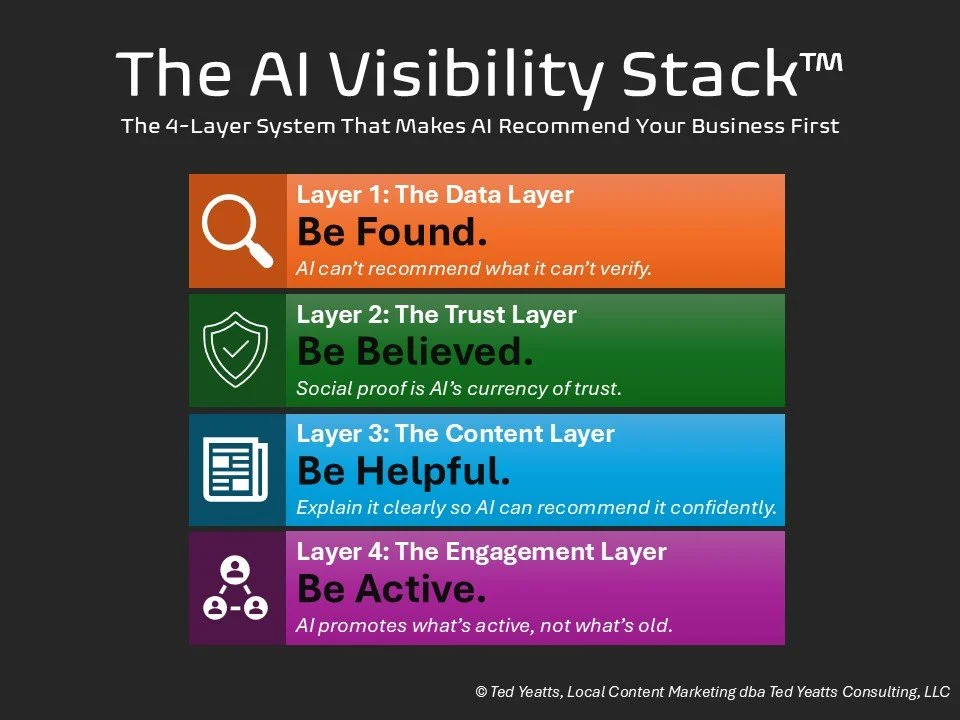
The AI Local Visibility Stack™ is Ted Yeatts’ four-layer framework for helping small and independent business owners understand what AI tools look for before they trust, cite, or recommend a business.
Think of it like a foundation.
If the lower layers are weak, everything above them becomes less reliable. If one layer is missing, AI has less confidence in the business.
AI tools are cautious. Before they recommend a local business, they look for signals that help answer four important questions:
Is the business information accurate?
Do real people trust this business?
Does this business help customers understand their options?
Is this business current, active, and engaged?
The AI Local Visibility Stack™ organizes those signals into four layers:
Data
Trust
Content
Engagement
Together, these layers help determine whether your business is easy for AI tools to understand, trust, cite, and recommend.
Layer One: Data
The first layer is Data.
This is the factual backbone of your business.
AI tools need to understand the basic facts:
Business name
Address
Phone number
Website
Services
Service areas
Hours
Licenses
Business categories
Social profiles
Local listings
AI looks for agreement and consistency.
When the same facts appear consistently across trusted sources, confidence starts to form. When AI sees conflicts, gaps, outdated listings, or unclear information, confidence drops.
This is where many local businesses lose visibility early.
The problem is often simple: the business is inconsistent across the internet.
Your website says one thing. Google says another. Facebook has an old phone number. Yelp lists outdated hours. A chamber profile uses a slightly different business name. Apple Maps has an old address. An industry directory lists services you no longer offer.
Those small inconsistencies create uncertainty.
And uncertainty makes AI hesitate.
What to improve in the Data Layer
Your first action item is to make sure your core business data is consistent across every major place your business appears online.
That includes:
Your website
Google Business Profile
Apple Maps
Bing Places
Yelp
Facebook
LinkedIn
Nextdoor
Angi
BBB
Yellow Pages
Superpages
Chamber profiles
Civic groups
Local associations
Industry-specific directories
Advertising profiles
Podcast profiles
YouTube descriptions
Social media bios
Any other public listing or platform
There is also a technical component to this layer: schema markup.
Schema markup helps search engines and AI-adjacent systems read and understand your business data more clearly. It can identify your organization, founder, location, services, offers, pages, FAQs, reviews, and other important information.
The Data Layer gives AI the facts it needs to understand who you are.
Layer Two: Trust
The second layer is Trust.
This is where AI asks a different question:
Do real people actually choose this business?
Trust signals help AI understand whether your business has evidence behind it.
This layer includes:
Reviews
Review volume
Review recency
Review specificity
Review response behavior
Testimonials
Customer stories
Third-party mentions
Local associations
Professional memberships
Community involvement
Reddit mentions
Social proof
Media mentions
Industry recognition
AI does not read reviews exactly like a human.
It looks for patterns.
It looks at consistency, volume, recency, sentiment, response behavior, and whether customers mention the same strengths again and again.
Winning the Trust Layer does not require perfection.
A business with steady, real, specific proof often feels safer to recommend than a business with silence. A few imperfect reviews can even make the overall profile feel more believable, especially when the business responds well and shows customers that someone is paying attention.
Trust grows through signal strength over time.
What to improve in the Trust Layer
Get more real, honest, specific reviews.
The best reviews mention what actually makes your business different.
Then reply to every review with a real, personal, specific response.
Avoid form replies.
A review response should show that a real person read the review, appreciated the customer, and understood what mattered about the experience.
The Trust Layer gives AI evidence that real people choose, trust, and value your business.
Layer Three: Content
The third layer is Content.
This is where AI tries to understand your business in context.
AI wants more than polished marketing copy. It needs helpful explanations, specific answers, customer education, and proof that your business understands the problems your customers are trying to solve.
This is where small businesses have a major opportunity.
Your customers have questions before they choose a business.
They want to know:
What should I look for?
What should I avoid?
Who can I trust?
What does this service include?
How do I compare my options?
What mistakes should I avoid?
What does this cost?
What makes one business better than another?
What should I know before I decide?
Your content should answer those questions.
This is part of what Ted calls The Helper Economy.
AI prefers businesses that teach. People prefer businesses that help before asking for anything.
Helpful content reduces uncertainty. It lowers anxiety. It gives customers confidence. It proves your expertise before the sales conversation begins.
That is a major advantage for independent businesses.
Big brands often struggle to sound personal, specific, and genuinely helpful at the local level. Independent businesses can use helpful content to show real expertise, local knowledge, customer understanding, and trustworthiness.
What to improve in the Content Layer
Turn your website and social media into a bank of helpful content that proves you are a local expert.
Start by answering the real questions customers ask every day.
Create content such as:
Service pages
FAQ sections
Resource articles
Short videos
YouTube videos
Podcast episodes
Social media posts
Comparison guides
Local guides
Customer problem pages
Decision-making guides
“What to know before you hire” content
For social media, shift the focus from promotion to helpfulness.
Instead of only posting about your business, answer the questions your ideal customers are already asking.
A strong post might begin with:
Here’s a question we get all the time, so we made a quick video to help.
That kind of content cuts through the noise because it serves the customer first.
The Content Layer gives AI useful material to understand your expertise and connect your business to customer questions.
Layer Four: Engagement
The fourth layer is Engagement.
This is how AI gauges whether your business is current, active, responsive, and involved.
AI is cautious about recommending businesses that look dormant.
Silence can look like risk.
When reviews are old, social channels are inactive, comments go unanswered, and public profiles feel stale, customers may wonder whether the business is still paying attention. AI tools can interpret those weak signals in a similar way.
Engagement signals include:
Recent reviews
Review responses
Social media activity
Comment replies
Updated website content
Fresh FAQs
New videos
Current business listings
Recent local mentions
Active Google Business Profile updates
Podcast or YouTube activity
Community interaction
Responses to customer questions
Activity creates reliability.
A business that responds, updates, answers, and participates sends a stronger signal than a business that appears inactive.
This layer often makes the difference between being mentioned occasionally and being recommended more consistently.
What to improve in the Engagement Layer
Every review should get a real, personal, specific response.
Every meaningful comment on Facebook, Instagram, YouTube, LinkedIn, TikTok, Lemon8, X, UpScrolled, and whatever platform comes next should get a real response.
Use at least seven words when possible.
That may sound like a lot of work because it is.
But in 2026, engagement is part of the business.
Customers are watching. AI tools are watching. Public signals matter.
If your business does not have time to respond, update, and stay active, hire help or create a system for making it happen.
The Engagement Layer shows AI that your business is alive, responsive, and involved.
How the AI Local Visibility Stack™ Works Together
Here is the key insight: AI does not evaluate these layers in isolation.
It stacks them.
Strong data supports trust. Trust supports content. Content supports engagement. Engagement reinforces the entire system.
A weakness in one layer creates weakness in the layers above it.
That is why two businesses can look similar on the surface, but only one gets recommended.
One business may have consistent data, strong reviews, helpful content, and active engagement.
The other may have scattered listings, thin content, old reviews, and no recent activity.
To a customer, the difference may not be obvious at first glance.
To AI, the stronger stack creates more confidence, which can improve your chances of being cited and recommended.
How Ted Helps Improve AI Visibility
Ted helps small and independent business owners improve AI visibility by strengthening the signals that matter most.
1. Clear Positioning
AI tools need to understand what your business is, who you help, and why you are relevant.
Ted helps sharpen your positioning so your website clearly communicates:
Your business category
Your core services
Your target customer
Your local market
Your value proposition
Your strongest differentiators
The problems customers hire you to solve
Clear positioning helps customers, search engines, and AI tools understand where your business fits.
2. Helpful Content
AI tools need useful answers.
Ted helps identify the questions your customers are already asking and turns those questions into helpful, specific content.
This may include:
Resource pages
FAQ sections
Service explanations
Comparison pages
Decision guides
Local authority content
Customer problem pages
Practical how-to content
Helpful content gives AI tools more reasons to understand, cite, and recommend your business.
3. Customer-Focused Service Pages
Many websites describe services from the business owner’s point of view.
Strong AI Visibility requires service pages that answer the customer’s real questions.
Ted helps improve service pages so they explain:
What the service is
Who it is for
What problems it solves
How the process works
What outcomes customers want
Why the business is qualified
What makes the service different
How to take the next step
Customer-focused service pages help AI tools connect your business to real buyer questions.
4. Schema Markup
Schema markup helps search engines and AI-adjacent systems better understand the structure and meaning of your website.
Ted helps create practical schema markup for key pages such as:
Homepage
About page
Service pages
Resource pages
FAQ sections
Framework pages
Offer pages
Local authority pages
Schema does not guarantee AI recommendations, but it can make your business information easier to interpret.
5. Local Authority
AI tools look for trust signals beyond a single webpage.
Ted helps independent businesses strengthen local authority through:
Clear local positioning
Helpful local content
Customer reviews
Google Business Profile alignment
Local partnerships
Community involvement
Local media mentions
Podcasts
Videos
Customer stories
Consistent online profiles
Local authority helps your business become easier to trust.
6. Reviews and Reputation
Reviews give customers and AI tools evidence that people have worked with you, trusted you, and had a positive experience.
Ted helps connect your review strategy to your positioning, customer experience, and service pages.
That may include:
Review prompts
Review language strategy
Reputation themes
Customer story development
Testimonial placement
Service-specific proof
Local trust signals
Reviews are strongest when they support the exact reasons customers should choose your business.
7. Entity Consistency
AI tools need consistent information about your business.
Entity consistency means your business is described clearly and consistently across your website, social profiles, listings, content, podcasts, videos, and third-party mentions.
Ted helps align important business facts such as:
Business name
Owner or founder name
Location
Services
Specialty
Target customer
Website URL
Social profiles
Business category
Core positioning
Consistency helps reduce confusion and strengthen trust.
8. Practical Answers to Customer Questions
Your future customers are asking questions before they buy.
Ted helps you identify and answer questions such as:
Who should I hire?
What service do I need?
How do I compare my options?
What should this cost?
What should I look for?
What mistakes should I avoid?
What is the best solution for my situation?
Who is the right expert for this problem?
When your business answers those questions clearly, you become more helpful to customers and easier for AI tools to cite.
What Makes AI Visibility Different From Traditional SEO?
Traditional SEO often focuses on rankings, keywords, links, and search traffic.
AI Visibility focuses on whether AI tools can confidently understand and recommend your business when customers ask natural-language questions.
That means the work needs to go deeper than keyword placement.
AI Visibility includes:
Stronger positioning
Better answer-first content
Clear service explanations
Better entity signals
Helpful FAQ content
Structured data
Review alignment
Local authority
Competitor comparison
Trust-building content
Consistent information across the web
The goal is to help your business become the kind of answer AI tools can understand and trust.
Who AI Visibility is For
AI Visibility may be especially valuable if you own or lead an independent business that depends on trust, reputation, expertise, local presence, or customer relationships.
This may be a strong fit for:
Independent business owners
Local service businesses
Professional service firms
Hospitality businesses
Wellness businesses
Spas and salons
Restaurants
Retail businesses
Home service businesses
Medical, dental, or health-related local practices
Consultants and coaches
Family-owned businesses
Owner-led companies
Businesses competing against chains, franchises, or larger brands
AI Visibility may be especially important if:
Customers research before they contact you
Your competitors are more visible online
Your website does not clearly explain your expertise
Your service pages feel thin or generic
Your reviews are strong but disconnected from your messaging
Your business has local authority that is not reflected online
You want AI tools to understand what makes your business recommendable
You want to build trust before customers reach out
What Ted Looks For in an AI Visibility Report
Ted reviews the signals that help AI tools understand, trust, cite, and recommend a business.
1. Business Understanding
Can AI tools quickly understand who you are, what you do, who you help, and where you serve?
2. Category Relevance
Is your business clearly connected to the services and customer problems you want to be known for?
3. Service Page Strength
Do your service pages answer the questions customers ask before they buy?
4. Helpful Content
Does your website provide useful answers to real customer questions?
5. Entity Signals
Is your business described consistently across your site and the wider web?
6. Schema Markup
Does your site use structured data to help explain people, organizations, services, pages, FAQs, and offers?
7. Local Authority
Does your business show signs of trust in your market?
8. Reviews and Proof
Do your reviews, testimonials, and customer stories support the reasons someone should choose you?
9. Competitor Visibility
Are competitors easier for AI tools to find, understand, cite, or recommend?
10. Action Steps
What should be improved first to make your business more recommendable by AI?
Your Free AI Visibility Report
Your free AI Visibility Report is designed to be practical, specific, and easy to act on.
You will see:
Where your business stands today
How AI tools may understand your business
Where your competitors may have an advantage
What signals are missing or weak
What pages need improvement
What customer questions you should answer
What content opportunities matter most
What schema or entity improvements may help
Which steps can make your business more recommendable by AI
The report shows you your starting point and gives you a customized checklist.
How the Process Works
Step 1: Request Your Free AI Visibility Report
Start by sharing your website URL and a few basic details about your business.
Ted reviews the visible signals that affect AI Visibility, including your website, positioning, content, service pages, schema, local authority, and competitor landscape.
Step 2: See Where You Stand
Your report shows how understandable, trustworthy, and recommendable your business appears based on the signals AI tools are likely to use.
You will see what is working, what is missing, and where competitors may be stronger.
Step 3: Review Practical Next Steps
Ted identifies the highest-priority improvements that can make your business easier for AI tools to understand, trust, cite, and recommend.
Step 4: Decide What to Improve First
Some businesses need better service pages. Others need a stronger About page, clearer positioning, FAQ content, schema markup, review alignment, or local authority content.
Your next steps should match the actual gaps in your business.
Why Ted Yeatts Is Focused on AI Visibility
Ted Yeatts works with independent business owners who need to compete against larger brands, national chains, franchises, and better-funded competitors.
AI Visibility fits directly into that challenge.
The businesses that win in AI search will likely be the businesses that are easiest to understand, easiest to trust, and easiest to recommend.
Ted helps independent business owners strengthen those signals by connecting AI Visibility to the same fundamentals that drive real growth:
Local trust
Clear positioning
Helpful content
Referral strategy
Repeat business
Team consistency
Reviews
Owner accountability
Local authority
AI Visibility is an opportunity to make your real business strengths more visible to the tools customers are starting to use.
AI Visibility and The Independent Advantage Growth System™
Ted’s AI Visibility work connects naturally to The Independent Advantage Growth System™, his six-part framework for helping independent businesses compete against larger brands.
Customer Experience Advantage
A better customer experience creates stronger reviews, referrals, stories, and proof. Those signals help customers and AI tools understand why your business is worth recommending.
Referral Engine
Referral-worthy businesses create trust. When your website explains who you help and why customers recommend you, AI tools have more useful context.
Repeat Business System
Repeat customers signal customer satisfaction and loyalty. Strong repeat business stories can support trust and authority.
Team Engagement
Your team shapes the customer experience. Consistent service behaviors often lead to stronger reviews, better stories, and clearer reasons for customers to choose you.
Local Authority Marketing
AI Visibility depends heavily on local authority. Helpful content, community involvement, reviews, partnerships, and clear answers help your business become more trusted.
Owner Accountability
AI Visibility requires consistent improvement. Owners need to strengthen the right signals, publish useful content, improve pages, and keep the business information aligned over time.
Common AI Visibility Problems
The Business Is Hard to Categorize
AI tools need to understand what type of business you are. If your website uses vague language, AI tools may struggle to connect your business to the right customer questions.
The Website Does Not Answer Enough Questions
Customers ask specific questions before they buy. If your website only has broad service descriptions, AI tools may have fewer reasons to cite or recommend it.
The Service Pages Are Too Thin
A short service page may not explain who the service is for, what problem it solves, why the business is qualified, or how the process works.
The About Page Does Not Build the Entity
Your About page should help AI tools understand the person, business, experience, location, credibility, services, and authority behind the brand.
Reviews Are Disconnected From Positioning
Reviews are most powerful when they reinforce what the business wants to be known for.
Schema Markup Is Missing or Too Thin
Schema helps explain the structure of your website. It can identify your organization, founder, services, offers, pages, FAQs, articles, and local signals.
Competitors Have More Helpful Content
Competitors may win AI visibility because they have clearer service pages, stronger FAQs, better comparison content, more local authority, or more third-party mentions.
What Makes a Business Recommendable by AI?
AI tools need enough trustworthy information to connect your business to a customer’s question.
A more recommendable business usually has:
Clear category positioning
Specific service pages
Helpful answers to customer questions
Strong About page/entity page
Consistent business information
Local trust signals
Customer reviews
Third-party mentions
Schema markup
Internal links
Clear proof of expertise
Content that matches customer intent
A strong customer experience behind the marketing
AI Visibility helps build and organize those signals.
Results AI Visibility Can Help Support
Every business is different, and AI answers vary by tool, location, prompt, user, and timing.
AI Visibility work is designed to help support outcomes such as:
Better understanding of your business by AI tools
Stronger service page relevance
More helpful customer-focused content
Better local authority signals
More consistent entity information
Stronger connection between reviews and positioning
More structured website information
Improved chances of being cited or recommended
Better customer education before they contact you
Stronger trust before the sales conversation
AI Visibility cannot force an AI tool to recommend your business, but it can improve the signals those tools use to understand and evaluate you.
Frequently Asked Questions
-
AI Visibility is the process of helping AI search tools understand, trust, cite, and recommend your business when potential customers ask questions. It focuses on the signals that make your business easier to understand, including positioning, service pages, helpful content, schema markup, reviews, local authority, and entity consistency.
-
You improve your chances by making your business easier to understand and trust. That means creating clear service pages, answering customer questions, using schema markup, improving reviews, building local authority, keeping entity information consistent, and publishing helpful content that matches what customers ask.
-
No. AI answers vary by tool, user, location, timing, and prompt. No business can force an AI system to recommend them. Ted helps improve the signals that make your business easier for AI tools to understand, trust, cite, and recommend.
-
The AI Local Visibility Stack™ is Ted Yeatts’ four-layer framework for helping small and independent business owners understand what AI tools look for before recommending a local business. The four layers are Data, Trust, Content, and Engagement. Together, they help AI tools understand whether a business is accurate, trustworthy, helpful, current, and engaged.
-
A free AI Visibility Report shows where your business stands today and the steps you can take to make your business more recommendable by AI. It may include review of your positioning, website, service pages, content, schema markup, reviews, local authority, entity consistency, and competitor visibility.
-
AI Visibility and SEO are connected, but they are not identical. SEO often focuses on search rankings, keywords, links, and traffic. AI Visibility focuses on whether AI tools can understand, trust, cite, and recommend your business in answer-style search experiences.
-
AI Visibility matters because customers are beginning to use AI tools to research businesses, compare options, and make decisions. Small businesses need to be understandable, trustworthy, and easy to recommend when customers ask AI for help.
-
AI Visibility is useful for independent businesses, local service businesses, professional service firms, hospitality businesses, wellness businesses, restaurants, retailers, consultants, coaches, family-owned businesses, and owner-led companies that depend on trust, reputation, expertise, and customer relationships.
-
A business becomes more recommendable when AI tools can clearly understand what it does, who it helps, where it serves, why customers trust it, what problems it solves, and what proof supports its expertise. Helpful content, reviews, schema markup, local authority, and consistent entity information all help.
-
Schema markup can help search engines and AI-adjacent systems better understand the structure and meaning of a website. It does not guarantee recommendations, but it can make important information about your business, services, pages, FAQs, and offers easier to interpret.
-
AI Visibility improves over time as your website, content, schema, reviews, local authority, and entity signals become stronger and more consistent. Some improvements can be made quickly, while broader authority building usually requires ongoing work.
-
A free AI Visibility Report shows where your business stands today. It helps identify the most important gaps, competitor advantages, and practical steps you can take to make your business easier for AI tools to understand, trust, cite, and recommend.
Find Out If AI Can Understand and Recommend Your Business
Your future customers may already be asking AI tools who to trust, what to choose, and which business can help them solve a problem.
Make sure your business is easy to understand, easy to trust, and easier to recommend.
Ted Yeatts helps small and independent business owners improve AI Visibility through The AI Local Visibility Stack™, a practical framework built around Data, Trust, Content, and Engagement.
Start with a free AI Visibility Report and see exactly where your business stands today.